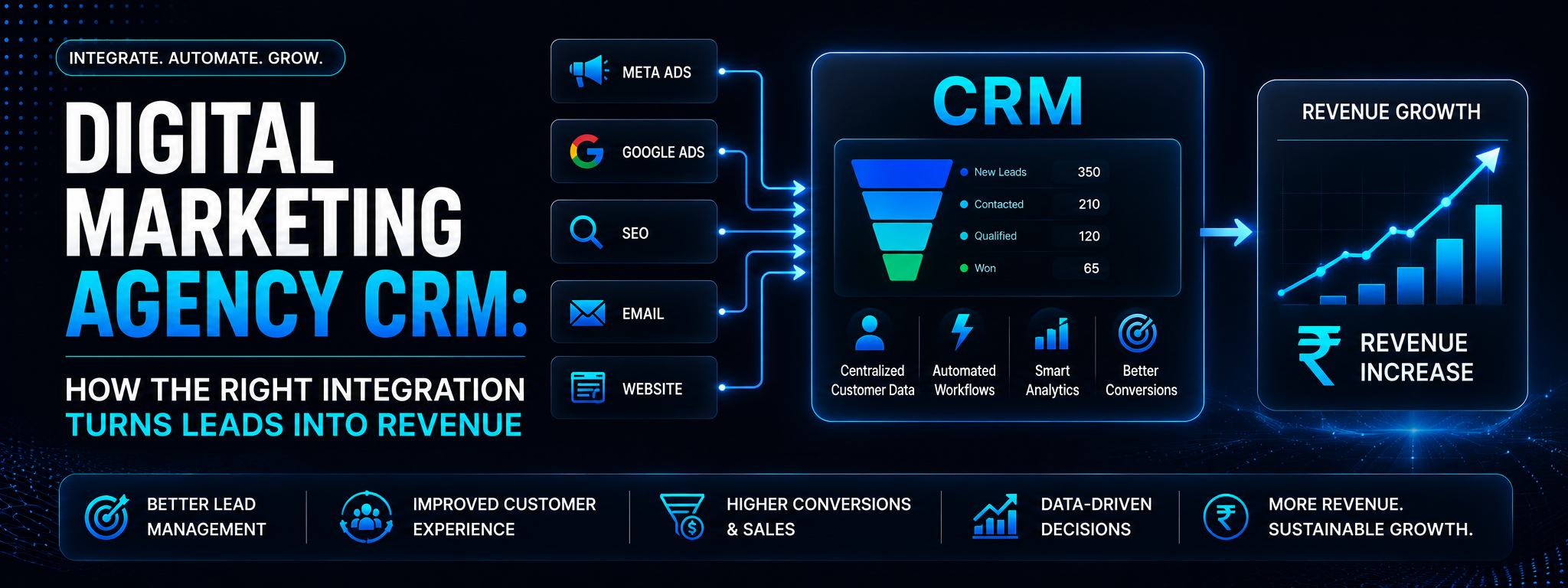
There's a version of digital marketing that costs a lot, generates a lot of leads, and converts very few of them. It looks busy. The reports are full of numbers. But when you trace those numbers back to actual revenue, the picture gets uncomfortable.
Then there's a different version — where every lead that comes in through a paid campaign, an SEO article, or a WhatsApp enquiry flows into a structured system that qualifies it, routes it to the right person, follows up automatically, and tracks it to a closed deal.
The difference between these two versions isn't the quality of the ads. It's whether the digital marketing agency has properly integrated a CRM into the marketing stack.
Why Most Agencies Keep Marketing and CRM Separate
The standard model for most digital marketing agencies is to operate at the top of the funnel. They manage your Meta and Google Ads campaigns, produce content, handle SEO services, and deliver a lead count at the end of the month.
What happens after a lead is generated is often left to the client's sales team. However, businesses looking for sustainable growth need more than just leads—they need a complete growth and lead generation strategy that connects marketing, CRM automation, and sales into one streamlined process.
This model made sense when CRM systems were expensive, complex, and required dedicated technical teams to maintain. That's no longer the case. Modern CRMs, particularly Zoho One and HubSpot, integrate seamlessly with advertising platforms while remaining affordable for businesses of all sizes.
Agencies that embrace a full-funnel growth and lead generation approach can track every stage of the customer journey, improve conversions, and deliver measurable business results instead of simply reporting lead numbers.
Agencies that haven't made this shift are either protecting a comfortable scope of work or simply lack the expertise to build across the full marketing stack. Either way, the client pays the price.
What a Proper Digital Marketing Agency CRM Integration Looks Like
Unified Lead Capture - Every entry point for a lead — Meta lead forms, Google landing pages, website contact forms, WhatsApp click-to-chat, Instagram DMs — is connected to a single CRM pipeline. No lead enters through a channel that isn't tracked and attributed.
Automatic Lead Routing - The CRM knows which campaign the lead came from, which service they enquired about, and which geography they're in. It automatically assigns the lead to the right salesperson or team based on these parameters — not a round-robin, but intelligent routing.
Speed-to-Lead Automation - Within seconds of a lead submission, the assigned salesperson gets a WhatsApp notification with the lead's details. An automated first-touch message goes out to the lead via WhatsApp or SMS acknowledging the enquiry and setting an expectation for when they'll be contacted.
Multi-Touch Follow-Up Sequences - Not every lead converts on the first call. A properly configured CRM runs automated follow-up sequences across email, WhatsApp, and SMS — triggered by pipeline stage and inactivity timers. A lead that didn't answer the first call automatically gets a WhatsApp message 4 hours later, an email the next morning, and another call attempt 48 hours after that — all without the salesperson having to remember to do it.
Lead Scoring - The CRM assigns a score to every lead based on their behaviour: did they visit the pricing page? Did they open the email? Did they click the case study link? High-scoring leads get prioritised. This prevents the common situation where a sales team wastes time on 50 cold leads while 10 hot ones sit uncontacted.
Revenue Attribution - Every closed deal is tagged with its original marketing source — campaign, ad set, keyword, and channel. This creates a direct line from marketing spend to revenue, so budget decisions are based on actual ROI rather than impression counts.
The Real Numbers: What This Integration Changes
When businesses move from disconnected marketing to an integrated CRM digital marketing agency model, the numbers that shift most dramatically are:
- Lead response time: drops from 4–24 hours to under 5 minutes
- Lead contact rate: increases from 40–50% to 80–90%
- Re-engagement revenue: 15–25% of 'dead' leads are recoverable with proper sequences
- Attribution clarity: marketing spend decisions become data-driven rather than intuition-based
The Zoho Stack for Digital Marketing + CRM Integration
For Indian businesses, Zoho One is our recommended foundation. Here's why it works particularly well for the marketing-to-CRM integration:
Zoho CRM ↔ Meta Ads: Zoho integrates natively with Meta's lead generation ads. When someone fills a Meta lead form, the contact appears in Zoho CRM within seconds — no Zapier, no manual import, no CSV upload.
Zoho CRM ↔ Google Ads: Conversion tracking connects Google Ads click data to Zoho CRM deal data. You can see which keywords are driving closed revenue, not just clicks.
Zoho Campaigns ↔ Zoho CRM: Email sequences triggered by CRM pipeline stage — not just a broadcast list. A lead that moves from 'Contacted' to 'Proposal Sent' automatically gets a different email sequence.
Zoho Analytics: Pulls data from CRM, Campaigns, and your ad platforms into unified dashboards. One screen shows you pipeline value, source breakdown, conversion rates, and revenue attribution — updated in real time.
Common Mistakes in Digital Marketing Agency CRM Setups
1. Using the wrong CRM for their sales motion: A CRM designed for enterprise B2B sales isn't the right tool for a high-volume B2C business, and vice versa.
2. Incomplete lead source tracking: If WhatsApp leads, website form leads, and referral leads all land in the same pipeline with no source tag, attribution becomes impossible.
3. No automation beyond lead entry: Many businesses set up a CRM but only use it as a digital contact book. The value is in the automation layer — the follow-up sequences, the scoring, the re-engagement.
4. Disconnected reporting: Running ad reports in Google Ads, pipeline reports in the CRM, and revenue reports in a spreadsheet means no one ever sees the full picture in one place.
If you're evaluating agencies to fix these issues, our guide to choosing the best CRM agency in Delhi covers exactly what separates competent implementers from transformative partners.
How EvoKast Approaches the Integration
EvoKast is a CRM automation agency in Delhi that builds the full stack — not just the CRM, and not just the marketing. Our engagements start with an audit of the current lead flow: where leads enter, where they get lost, and what the actual response rate and conversion rate looks like.
We're a Zoho Authorised Partner, which means we build on a platform we know deeply — not one we're learning on your project.
Explore our CRM and marketing automation services or book a free audit to see what the integration looks like for your business.