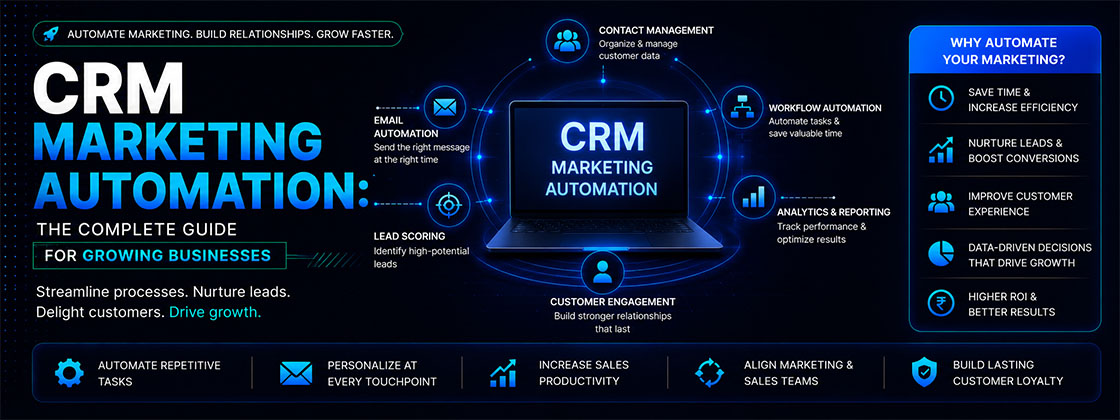
Businesses today generate more customer data than ever before. Every website visit, email click, inquiry, purchase, and support interaction creates valuable information. Managing this growing volume of customer data manually is no longer practical. As businesses scale, spreadsheets, manual follow-ups, and disconnected tools lead to missed opportunities, delayed responses, and lower conversion rates.
CRM Marketing Automation combines customer relationship management (CRM) with intelligent marketing automation to streamline repetitive tasks, nurture leads automatically, improve customer engagement, and increase sales efficiency. Instead of spending hours updating customer records or sending follow-up emails manually, businesses can automate these processes while delivering personalized experiences at every stage of the customer journey.
Whether you're a startup, SME, or enterprise, implementing CRM Marketing Automation helps your sales and marketing teams work together seamlessly. It enables faster lead qualification, automated workflows, better customer segmentation, improved reporting, and AI-powered decision-making—all from a centralized platform.
At Evokast Digital Ventures, we've seen businesses transform their operations by adopting modern CRM automation strategies. Organizations that integrate automation into their sales and marketing workflows often experience higher productivity, stronger customer relationships, and increased revenue growth while reducing operational costs.
What is CRM Marketing Automation?
CRM Marketing Automation is the process of using CRM software and automation technology to manage customer interactions, automate marketing campaigns, nurture leads, and optimize sales activities without requiring constant manual effort.
Instead of manually assigning leads, updating contact information, sending follow-up emails, or tracking customer interactions, automation performs these repetitive tasks based on predefined rules and customer behavior.
For example:
- A visitor downloads your eBook.
- The CRM automatically creates a lead profile.
- The lead receives a personalized welcome email.
- Based on engagement, the system assigns a lead score.
- A sales representative receives an automatic notification when the lead becomes sales-ready.
All of this happens automatically—saving valuable time while ensuring every lead receives timely communication.
Simply put, CRM Marketing Automation allows businesses to automate the complete customer lifecycle, from lead generation to customer retention.
How CRM Marketing Automation Works
Modern CRM Marketing Automation platforms operate using intelligent workflows built around triggers and actions.
Whenever a customer performs a specific activity, the system responds automatically.
Example Workflow
| Customer Action | Automated Response |
|---|---|
| Website form submitted | New contact created in CRM |
| Downloaded a brochure | Welcome email sent automatically |
| Visited pricing page multiple times | Lead score increases |
| Lead reaches qualification score | Sales team notified instantly |
| Customer completes purchase | Thank-you email and onboarding workflow begins |
| Customer inactive for 30 days | Re-engagement campaign starts automatically |
These automated workflows eliminate repetitive administrative work while ensuring customers receive consistent communication throughout their buying journey.
Instead of reacting manually, businesses proactively engage prospects at exactly the right time.
Why CRM Marketing Automation Matters for Growing Businesses
As businesses expand, customer interactions increase exponentially.
Managing hundreds—or even thousands—of prospects manually becomes nearly impossible.
Without automation, businesses often face:
- Missed follow-ups
- Inconsistent customer communication
- Duplicate data entries
- Lost sales opportunities
- Poor collaboration between marketing and sales
- Inefficient lead nurturing
- Lower conversion rates
CRM Marketing Automation solves these challenges by creating standardized workflows that operate around the clock.
This means your business continues nurturing leads, qualifying prospects, and engaging customers—even outside business hours.
Growing businesses particularly benefit because automation allows teams to handle significantly more customers without increasing operational workload.
Instead of hiring additional staff for repetitive tasks, companies invest in smarter systems that scale alongside their business.
Key Components of CRM Marketing Automation
An effective CRM Marketing Automation solution typically includes several integrated capabilities that work together.
1. Lead Management
Lead management is one of the most valuable automation features.
It automatically:
- Captures leads from websites
- Assigns leads to sales representatives
- Scores prospects based on engagement
- Tracks lead activity
- Updates pipeline stages
Sales teams can prioritize high-intent prospects instead of manually reviewing every inquiry.
2. Contact Management
Customer information remains centralized and updated automatically.
The CRM stores:
- Contact details
- Company information
- Communication history
- Purchase history
- Website activity
- Meeting notes
- Customer preferences
Having a complete customer profile enables personalized communication and stronger customer relationships.
3. Email Marketing Automation
Instead of sending individual emails manually, businesses can automate:
- Welcome emails
- Newsletter campaigns
- Product recommendations
- Promotional offers
- Follow-up sequences
- Event invitations
- Customer onboarding
- Re-engagement campaigns
This ensures customers receive relevant content based on their behavior and interests.
4. Sales Workflow Automation
Sales representatives spend less time on administrative work through automated:
- Task assignments
- Meeting reminders
- Proposal generation
- Follow-up scheduling
- Pipeline updates
- Deal stage movement
- Notification alerts
This allows sales professionals to focus on closing deals rather than updating spreadsheets.
5. Analytics and Reporting
One of the greatest strengths of CRM Marketing Automation is real-time reporting.
Businesses gain insights into:
- Lead conversion rates
- Campaign performance
- Sales pipeline health
- Revenue forecasting
- Customer acquisition costs
- Customer lifetime value
- Team productivity
These insights support data-driven business decisions instead of relying on assumptions.
CRM Marketing Automation vs. Marketing Automation
Many businesses assume CRM Automation and marketing automation are the same. While they work together, they serve different purposes.
| Feature | CRM Marketing Automation | Marketing Automation |
|---|---|---|
| Primary Focus | Customer relationship management | Marketing campaigns |
| Used By | Sales & Customer Success Teams | Marketing Teams |
| Goal | Convert leads and retain customers | Generate and nurture leads |
| Main Functions | Contact management, pipeline tracking, lead scoring, follow-ups | Email campaigns, landing pages, social media, campaign automation |
| Customer Stage | Mid to Bottom of Funnel | Top to Mid Funnel |
The real power comes when both systems are integrated.
For example:
- Marketing generates leads through campaigns.
- CRM Marketing Automation automatically captures those leads.
- Leads are scored based on behavior.
- Sales receives qualified prospects instantly.
- Customer interactions continue automatically after the purchase.
This creates a seamless customer journey from awareness to long-term loyalty.
Top Benefits of CRM Marketing Automation
Implementing CRM Automation delivers measurable business benefits beyond simply saving time.
1. Increases Team Productivity
Sales and marketing professionals often spend a significant portion of their day on repetitive administrative work.
Automation removes tasks like:
- Data entry
- Lead assignment
- Follow-up reminders
- Contact updates
- Email scheduling
Instead, teams can focus on revenue-generating activities such as closing deals, building relationships, and creating better marketing campaigns.
2. Improves Lead Management
Not every lead is ready to buy immediately.
A CRM Marketing Automation platform tracks customer behavior and automatically qualifies leads based on factors such as:
- Website visits
- Email opens
- Content downloads
- Demo requests
- Pricing page visits
- Form submissions
High-quality leads are automatically prioritized for sales teams.
3. Delivers Personalized Customer Experiences
Today's customers expect personalized communication.
Automation makes personalization possible by sending messages based on:
- Purchase history
- Customer interests
- Geographic location
- Website behavior
- Previous interactions
- Buying stage
Personalized experiences increase engagement, trust, and conversion rates.
4. Shortens the Sales Cycle
Following up at the right time can significantly impact conversions.
With CRM Marketing Automation, businesses can automatically:
- Schedule follow-up emails
- Notify sales representatives
- Trigger reminders
- Share product recommendations
- Send proposals instantly
Faster responses help move prospects through the sales funnel more efficiently.
5. Improves Customer Retention
Customer relationships shouldn't end after a sale.
Automation supports retention through:
- Customer onboarding
- Renewal reminders
- Product education
- Loyalty campaigns
- Feedback surveys
- Upselling opportunities
Retaining existing customers is often more cost-effective than acquiring new ones.
6. Better Collaboration Between Teams
Marketing and sales frequently work with separate systems, creating communication gaps.
A unified CRM Marketing Automation platform ensures:
- Shared customer data
- Unified dashboards
- Better reporting
- Accurate lead tracking
- Improved accountability
Everyone works from the same source of truth.
7. Smarter Business Decisions Through Analytics
Every customer interaction generates valuable insights.
Modern CRM platforms provide dashboards showing:
- Sales performance
- Campaign ROI
- Customer lifetime value
- Pipeline health
- Revenue forecasts
- Conversion rates
- Team productivity
These insights help leaders make data-driven decisions with confidence.
Features Every CRM Automation Platform Should Have
Choosing the right solution starts with understanding the features that matter most.
Lead Capture Automation
Automatically collect leads from:
- Website forms
- Landing pages
- Live chat
- Social media
- Google Ads
- Third-party applications
Contact Management
Maintain a centralized customer database that updates automatically across departments.
Email Workflow Automation
Build automated sequences for:
- Welcome emails
- Drip campaigns
- Lead nurturing
- Product launches
- Event registrations
- Customer onboarding
Lead Scoring
Assign scores based on customer engagement to help sales teams focus on high-intent prospects.
Sales Pipeline Automation
Automatically:
- Move deals between stages
- Assign tasks
- Generate reminders
- Notify stakeholders
Third-Party Integrations
Your CRM should integrate seamlessly with:
- Google Workspace
- Microsoft 365
- Slack
- WhatsApp Business
- Shopify
- WooCommerce
- HubSpot
- Zapier
- ERP systems
- Accounting software
Reports & Dashboards
Look for customizable dashboards that display KPIs such as:
- Revenue
- Marketing ROI
- Sales Forecast
- Lead Sources
- Customer Acquisition Cost
- Customer Retention
How AI is Transforming CRM Marketing Automation
Artificial Intelligence is taking CRM Marketing Automation to the next level.
Instead of simply automating tasks, AI helps businesses make smarter decisions.
Today's AI-powered CRM systems can:
- Predict which leads are most likely to convert.
- Recommend the next best action for sales teams.
- Personalize email campaigns automatically.
- Forecast future sales revenue.
- Analyze customer sentiment.
- Generate campaign insights.
- Detect inactive customers before they churn.
- Suggest upselling opportunities.
Generative AI is also helping marketing teams create personalized email content, product recommendations, chatbot responses, and customer support documentation in seconds.
Businesses adopting AI-driven CRM solutions gain a competitive advantage by improving efficiency while delivering more relevant customer experiences.
Common CRM Marketing Automation Mistakes to Avoid
Implementing CRM Marketing Automation can significantly improve your business operations, but only if it's executed strategically. Many businesses invest in CRM software expecting instant results, only to face challenges due to poor implementation. Avoiding these common mistakes can help maximize your return on investment.
1. Automating Without a Clear Strategy
One of the biggest mistakes businesses make is automating every process without first understanding their customer journey. Automation should simplify workflows—not complicate them.
Before setting up workflows, identify:
- Your sales funnel
- Customer touchpoints
- Marketing objectives
- Lead qualification process
- Customer retention strategy
A well-planned automation strategy delivers better results than automating random tasks.
2. Ignoring Data Quality
Your CRM is only as effective as the data it contains.
Duplicate records, outdated contact information, and incomplete customer profiles reduce automation accuracy and negatively impact marketing campaigns.
To maintain high-quality data:
- Remove duplicate contacts regularly.
- Verify customer information.
- Standardize data entry.
- Archive inactive leads.
- Schedule periodic CRM audits.
Clean data ensures better segmentation, reporting, and customer communication.
3. Sending Too Many Automated Emails
Automation should enhance customer relationships—not overwhelm customers with excessive communication.
Avoid:
- Daily promotional emails
- Irrelevant follow-ups
- Generic email sequences
- Duplicate campaigns
Instead, create personalized workflows based on customer behavior and preferences.
4. Not Aligning Sales and Marketing Teams
A successful CRM Marketing Automation strategy depends on collaboration between sales and marketing.
Both teams should agree on:
- Lead qualification criteria
- Customer lifecycle stages
- Campaign objectives
- Shared KPIs
- Follow-up processes
When both departments work from the same CRM platform, lead handoffs become seamless and conversion rates improve.
5. Skipping Team Training
Even the most advanced CRM platform cannot deliver results if employees don't know how to use it effectively.
Provide regular training sessions covering:
- CRM navigation
- Workflow management
- Lead tracking
- Reporting dashboards
- Automation best practices
A well-trained team drives higher adoption and better ROI.
How to Choose the Right CRM Marketing Automation Software
Selecting the right CRM Marketing Automation is one of the most important business decisions for long-term growth. The ideal solution should align with your goals, workflows, and future expansion plans.
Ease of Use
Choose software with an intuitive interface that your team can adopt quickly without extensive technical training.
Automation Capabilities
Look for features such as:
- Lead nurturing workflows
- Email automation
- Lead scoring
- Task automation
- Workflow builders
- Customer journey automation
AI-Powered Features
Modern CRM platforms should offer AI capabilities like:
- Predictive lead scoring
- Sales forecasting
- Intelligent recommendations
- AI-generated email content
- Customer behavior analysis
Integration Options
Ensure the CRM integrates seamlessly with your existing business tools, including:
- ERP software
- Accounting systems
- Email platforms
- Marketing tools
- Social media platforms
- Customer support software
Reporting & Analytics
Choose software that provides real-time dashboards and customizable reports to monitor:
- Lead conversion rates
- Marketing ROI
- Sales performance
- Customer engagement
- Revenue growth
Scalability
As your business grows, your CRM should scale effortlessly by supporting:
- Additional users
- New automation workflows
- Multiple sales pipelines
- Advanced integrations
- Larger customer databases
Why Choose Evokast Digital Ventures for CRM Marketing Automation?
Implementing CRM Marketing Automation is more than selecting the right software—it's about creating a connected ecosystem that improves customer experiences and drives business growth.
Evokast Digital Ventures helps businesses design, implement, and optimize CRM automation strategies tailored to their unique goals. Our team focuses on building scalable solutions that integrate marketing, sales, and customer service into a unified system.
Our CRM Marketing Automation services include:
- CRM implementation and customization
- Marketing automation strategy
- Lead nurturing workflow design
- Email automation setup
- Sales pipeline optimization
- CRM integration with third-party tools
- AI-powered automation solutions
- Performance monitoring and optimization
Whether you're a startup looking to streamline lead management or an enterprise aiming to improve customer engagement, Evokast Digital Ventures delivers automation solutions that support sustainable business growth.
Conclusion
As businesses continue to grow in an increasingly competitive digital landscape, manual processes are no longer sufficient to manage customer relationships effectively. CRM Marketing Automation empowers organizations to automate repetitive tasks, improve lead management, personalize customer interactions, and make data-driven decisions that fuel long-term success.
From capturing leads and automating follow-ups to leveraging AI for predictive insights, CRM Marketing Automation enables businesses to deliver exceptional customer experiences while improving operational efficiency. By integrating sales, marketing, and customer service into one connected platform, companies can reduce manual effort, shorten sales cycles, and maximize return on investment.
The key to success lies in selecting the right CRM platform, maintaining clean customer data, aligning teams, and continuously optimizing automation workflows based on performance insights.
If you're ready to transform your customer engagement strategy, Evokast Digital Ventures can help you implement intelligent CRM Marketing Automation solutions that scale with your business and drive measurable results.