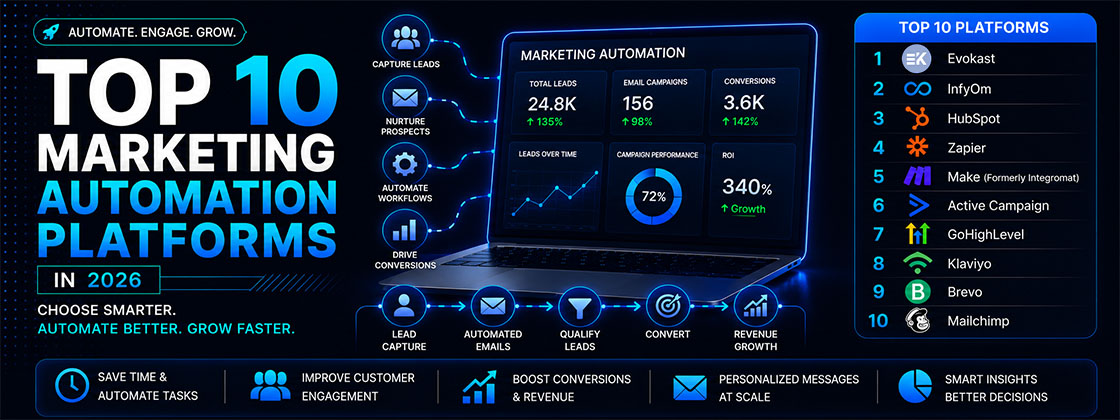
Every business wants more leads, faster conversions, and stronger customer relationships. However, many still rely on disconnected tools and manual processes that slow growth and reduce efficiency.
That's why partnering with a marketing automation agency has become increasingly important. Modern marketing automation platforms integrate your CRM, website, email, WhatsApp, and sales pipeline into one intelligent system, helping businesses automate repetitive tasks, nurture leads, and improve customer engagement.
With AI-powered automation and CRM automation services, businesses can qualify leads, personalize customer interactions, streamline workflows, and increase productivity while reducing manual effort.
In this guide, we've compared the top 10 marketing automation based on features, AI capabilities, CRM integration, pricing, and overall business value to help you choose the right solution for your business.
What is a marketing automation platform?
A marketing automation platform is software that helps businesses automate repetitive marketing and sales tasks, improving efficiency and customer engagement. Modern platforms use AI to streamline workflows such as lead management, email marketing, CRM updates, WhatsApp communication, and customer follow-ups.
Common uses of marketing automation include:
- AI-powered workflow automation
- CRM and lead management
- Email and WhatsApp automation
- Sales follow-ups
- Customer journey automation
- Analytics and reporting
By automating these processes, businesses can save time, improve lead conversions, and focus on growing their business instead of managing repetitive tasks.
Why Businesses Need Marketing Automation in 2026
Customer expectations have changed dramatically. People expect instant responses, personalized communication, and seamless interactions across multiple channels. Businesses that continue relying on manual processes often struggle to keep up with these expectations.
Marketing automation helps organizations remain competitive by improving efficiency, increasing conversion rates, and delivering better customer experiences.
Some of the biggest benefits include:
Save Time: Automating repetitive activities like follow-up emails, lead assignments, and reporting allows teams to focus on strategic work rather than administrative tasks.
Improve Lead Conversion: Automated nurturing campaigns keep prospects engaged until they are ready to make a purchase, reducing the chances of losing potential customers.
Better Customer Experience: Automation enables businesses to deliver timely, personalized messages based on customer behavior instead of generic campaigns.
Stronger Sales and Marketing Alignment: When CRM and marketing automation work together, both teams have access to the same customer data, resulting in better collaboration and higher conversion rates.
AI-Powered Decision Making: Many modern platforms now use AI to recommend actions, identify high-quality leads, predict customer behavior, and optimize campaign performance.
How We Selected These Marketing Automation Platforms
Every platform featured in this guide was evaluated using practical business criteria instead of marketing claims. We considered solutions suitable for startups, growing businesses, agencies, ecommerce brands, and enterprise organizations.
Our evaluation focused on:
- Automation capabilities
- CRM integration
- AI-powered features
- Ease of implementation
- Workflow customization
- Customer support
- Reporting and analytics
- Scalability
- Overall value for money
Rather than selecting platforms based solely on popularity, we prioritized solutions that help businesses automate marketing, improve operational efficiency, and support long-term growth.
Quick Comparison of the Marketing Automation Platforms
| Platform | Best For | AI Features | CRM | Ease of Use | |
|---|---|---|---|---|---|
| Zoho Marketing Automation | Marketing Automation for SMBs | ✅ | ✅ | Limited | ⭐⭐⭐⭐☆ |
| InfyOm | AI Development & Custom Software | ✅ | Partial | Limited | ⭐⭐⭐⭐☆ |
| HubSpot | Enterprise CRM & Marketing | ✅ | ✅ | Limited | ⭐⭐⭐⭐☆ |
| Zapier | Workflow Integrations | Partial | ❌ | ❌ | ⭐⭐⭐⭐⭐ |
| Make | Advanced Workflow Automation | Partial | ❌ | ❌ | ⭐⭐⭐⭐☆ |
| ActiveCampaign | Email Marketing & CRM | ✅ | ✅ | Limited | ⭐⭐⭐⭐☆ |
| GoHighLevel | Marketing Agencies | ✅ | ✅ | ✅ | ⭐⭐⭐⭐☆ |
| Klaviyo | Ecommerce Marketing | ✅ | Partial | Limited | ⭐⭐⭐⭐☆ |
| Brevo | Small Business Marketing | ✅ | ✅ | Limited | ⭐⭐⭐⭐☆ |
| Mailchimp | Email Marketing Campaigns | Partial | Partial | ❌ | ⭐⭐⭐⭐☆ |
Evokast
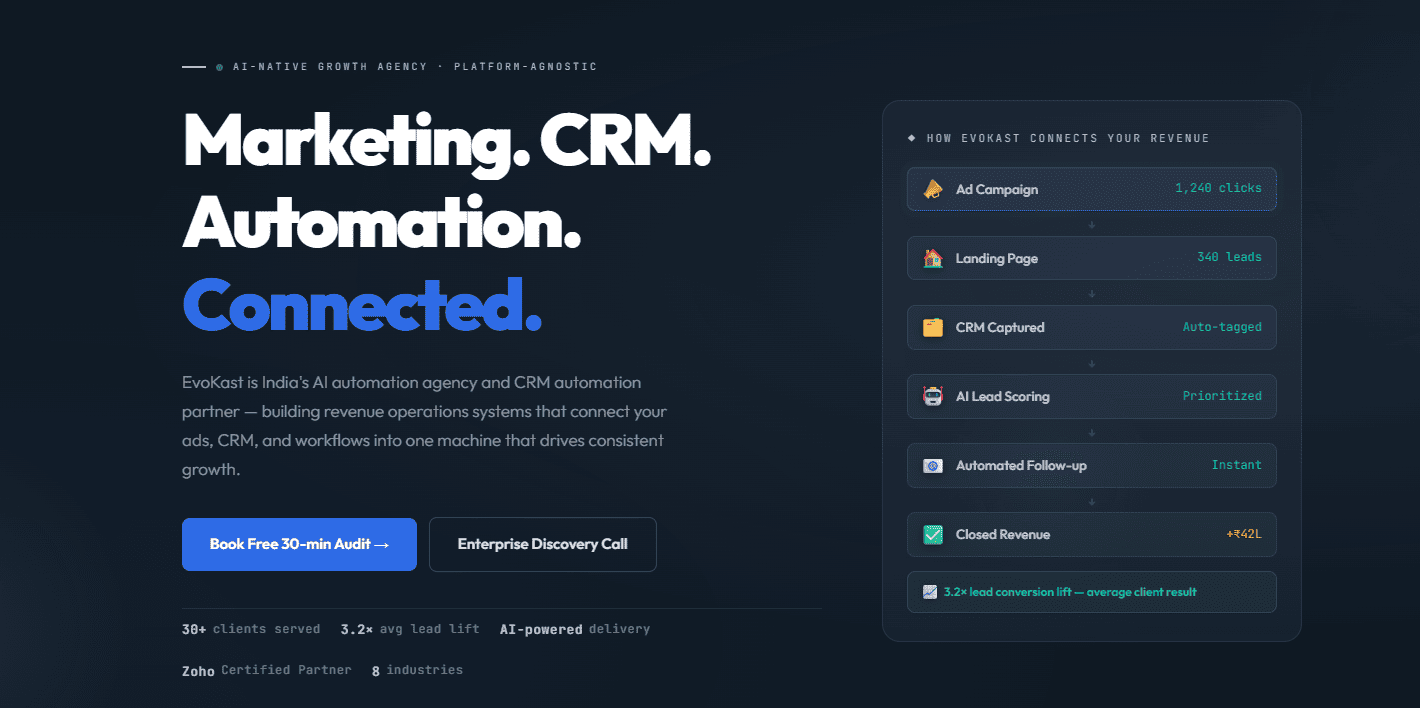
Best For: Marketing Automation Implementation, CRM Implementation, AI Automation Services, WhatsApp Automation, Workflow Automation, Platform Integration, Lead Management
Choosing the right marketing automation platform is only the first step toward improving business efficiency. Whether you select HubSpot, Zoho Marketing Automation, ActiveCampaign, Brevo, Mailchimp, or any other platform, successful results depend on proper implementation, integration, and ongoing optimization. Without the right setup, businesses often struggle with disconnected systems, inefficient workflows, poor CRM adoption, and underutilized automation features.
Evokast is an AI automation and CRM implementation service provider that helps businesses successfully deploy and optimize marketing automation platforms based on their unique business requirements. Rather than selling another marketing automation platform, our team works alongside your business to configure the platform you choose, ensuring it integrates seamlessly with your CRM, website, WhatsApp Business API, lead generation channels, and internal business processes.
From automation strategy and CRM implementation to workflow design, lead nurturing, API integrations, AI-powered automation, WhatsApp automation, and custom business process automation, Evokast delivers end-to-end implementation services that help businesses maximize the value of their technology investment. We also provide migration, employee onboarding, optimization, and ongoing support to ensure your marketing automation platform continues to deliver measurable business results.
Whether you're implementing a new platform or improving an existing setup, Evokast helps you transform powerful marketing automation software into a fully integrated, scalable solution that increases productivity, improves customer engagement, streamlines sales processes, and maximizes ROI.
Key Implementation Services
Instead of providing another marketing automation platform, Evokast helps businesses implement, customize, integrate, and optimize the platform that best fits their needs.
Some of its standout features include:
- AI-powered workflow automation
- CRM implementation and customization
- Lead capture and automated lead assignment
- WhatsApp Business API integration
- Email marketing automation
- AI chatbot integration
- Sales pipeline automation
- Customer journey mapping
- Automated reminders and follow-ups
- Dashboard reporting and analytics
- Third-party software integrations
- Custom API development
Whether you're running paid advertising campaigns, generating leads through SEO, or collecting enquiries from your website, Evokast ensures every lead enters a structured workflow without manual intervention.
Why Businesses Choose Evokast Digital Ventures
Many businesses start with separate tools for CRM, email marketing, customer support, and reporting. As the company grows, managing these disconnected systems becomes increasingly difficult.
Evokast solves this challenge by creating one connected ecosystem where every department works from the same data.
For example, when a visitor submits a contact form:
- The lead is automatically saved inside the CRM.
- A personalized email is triggered instantly.
- A WhatsApp message confirms the enquiry.
- The lead is assigned to the appropriate salesperson.
- Sales managers receive notifications.
- Follow-up reminders are automatically scheduled.
- Customer interactions are tracked in one dashboard.
This significantly reduces manual work while improving customer response times and lead conversion rates.
Pros
- Complete AI and CRM automation
- Custom workflow development
- WhatsApp automation
- Personalized implementation support
- Flexible integrations
- Scalable for growing businesses
- Centralized reporting
- Business-specific automation
Cons
- Custom pricing instead of fixed packages
- Advanced implementations may require initial consultation
1. Zoho Marketing Automation
Best For: Email Marketing, Customer Journey Automation, Lead Nurturing, CRM Integration, SMBs & Growing Businesses
Zoho Marketing Automation is a comprehensive marketing automation platform designed to help businesses attract, engage, and convert leads through personalized customer journeys. It enables marketing teams to automate email campaigns, lead nurturing, audience segmentation, landing pages, forms, and multi-channel marketing from a centralized dashboard. With native integration across the Zoho ecosystem—especially Zoho CRM—businesses can align their marketing and sales efforts while gaining deeper insights into customer behavior and campaign performance.
The platform supports workflow automation, lead scoring, behavioral tracking, web forms, and campaign analytics, making it a strong choice for small and medium-sized businesses looking to scale their marketing operations without investing in enterprise-level software. Its intuitive interface and flexible automation capabilities help organizations improve customer engagement, increase conversions, and reduce manual marketing tasks.
To maximize the value of Zoho Marketing Automation, businesses often require expert implementation, CRM customization, workflow configuration, data migration, third-party integrations, and employee onboarding. Working with an experienced implementation partner like Evokast ensures the platform is configured according to your business processes, integrates seamlessly with your existing systems, and delivers measurable results through optimized automation strategies.
2. InfyOm
Best For: AI Development, Enterprise Software, Workflow Automation
InfyOm focuses primarily on AI-powered software development and business automation services. Rather than offering a traditional marketing automation platform, the company specializes in developing custom AI applications, intelligent business workflows, AI agents, enterprise software, and automation solutions tailored to specific industries.
Businesses requiring highly customized software development projects often consider InfyOm because of its expertise in artificial intelligence and enterprise application development.
Some of its core services include:
- AI agent development
- Workflow automation
- Custom CRM solutions
- Business software development
- AI chatbot implementation
- Enterprise automation
This makes InfyOm a suitable technology partner for organizations that need custom-built applications rather than a ready-to-use marketing platform.
However, businesses specifically searching for marketing automation—including CRM automation, WhatsApp communication, lead nurturing, campaign management, and customer engagement—may require additional software integrations.
For companies wanting marketing, CRM, AI automation, and customer communication under one ecosystem, Evokast provides a more complete business automation solution.
Pros
- Strong AI expertise
- Custom software development
- Enterprise workflow automation
- Experienced development team
Cons
- More development-focused than marketing-focused
- May require additional marketing software
3. HubSpot
Best For: Businesses seeking an all-in-one CRM and marketing solution
HubSpot is one of the most recognized names in marketing technology. It combines CRM, marketing automation, customer service, sales tools, content management, and reporting into one platform.
Marketing teams use HubSpot to:
- Create landing pages
- Automate email campaigns
- Manage customer relationships
- Track sales opportunities
- Analyze campaign performance
One of its strongest advantages is usability. Even businesses with limited technical expertise can build marketing campaigns using its visual workflow builder.
However, as contact lists grow and advanced automation becomes necessary, subscription costs can increase significantly.
Pros
- Excellent CRM
- User-friendly interface
- Powerful reporting
- Large integration marketplace
Cons
- Premium features are expensive
- Costs increase as businesses scale
4. Zapier
Best For: Connecting thousands of applications
Zapier has become the industry standard for no-code integrations. Rather than functioning as a complete marketing platform, Zapier connects different software applications so information automatically flows between them.
Businesses commonly use Zapier to connect:
- Google Sheets
- Gmail
- Slack
- Shopify
- Salesforce
- HubSpot
- Trello
- Stripe
- WordPress
Its workflow builder allows users to automate repetitive administrative tasks without writing code.
For example:
A new website enquiry can automatically:
- Create a CRM contact
- Notify Slack
- Send an email
- Update Google Sheets
- Create a task in Asana
This flexibility makes Zapier valuable for businesses already using multiple SaaS platforms.
However, Zapier is an integration platform—not a complete CRM or marketing automation system.
Pros
- Thousands of integrations
- Easy setup
- No-code workflows
- Reliable automation
Cons
- Not a complete marketing platform
- Costs increase with automation volume
5. Make (Formerly Integromat)
Best For: Advanced workflow automation
Make provides one of the most powerful visual workflow builders available today.
Compared to simpler automation tools, Make allows businesses to create sophisticated workflows involving APIs, databases, conditional logic, routers, filters, and advanced automation scenarios.
It is especially popular among developers and technically skilled marketing teams.
Businesses use Make to automate:
- CRM synchronization
- Ecommerce orders
- Customer notifications
- Invoice generation
- API integrations
- Inventory management
- Internal business workflows
The platform supports thousands of applications while allowing much deeper customization than basic integration tools.
Its biggest strength is flexibility.
Its biggest drawback is complexity.
New users often require additional learning before creating advanced workflows.
For organizations looking for business automation without technical complexity, platforms like Evokast provide implementation support alongside automation technology, reducing the learning curve while delivering customized workflows.
Pros
- Extremely flexible
- Advanced workflow builder
- Powerful API integrations
- Visual automation interface
Cons
- Steeper learning curve
- Better suited for technical users
6. Active Campaign
Best For: Email Marketing, Customer Journey Automation & CRM
ActiveCampaign has earned a strong reputation for helping businesses create highly personalized customer experiences. Unlike basic email marketing platforms, it combines email automation with CRM capabilities, lead scoring, behavioral tracking, and sales automation.
The platform enables businesses to build automated customer journeys based on user actions. Whether a customer visits a pricing page, downloads an ebook, or abandons a shopping cart, ActiveCampaign can automatically trigger emails, assign leads to sales representatives, and update CRM records.
Some of its most valuable features include:
- Email marketing automation
- Customer segmentation
- Lead scoring
- CRM integration
- Sales automation
- Dynamic email personalization
- Customer journey builder
- Analytics and reporting
For businesses focused heavily on email marketing, ActiveCampaign offers one of the most advanced automation engines available.
However, organizations looking for AI workflow automation, WhatsApp integration, business process automation, and customized CRM implementation may eventually need additional software.
Pros
- Excellent email automation
- Powerful workflow builder
- Built-in CRM
- Strong customer segmentation
Cons
- Limited business workflow automation
- Advanced features require higher plans
7. GoHighLevel
Best For: Digital Marketing Agencies
GoHighLevel has become one of the most popular platforms among marketing agencies because it combines multiple business tools into a single dashboard.
Instead of using separate applications for CRM, landing pages, email campaigns, appointment scheduling, reputation management, SMS marketing, and funnels, agencies can manage everything from one platform.
Key features include:
- CRM
- Sales funnels
- Landing pages
- SMS automation
- Email marketing
- Appointment booking
- Pipeline management
- White-label solution
- Client reporting
One of GoHighLevel's biggest advantages is its white-label capability, allowing agencies to brand the software as their own platform.
Although it works exceptionally well for agencies, businesses outside the agency model may find several features unnecessary.
Organizations requiring customized AI automation, CRM implementation, and business workflow automation often prefer solutions tailored specifically to their operational needs.
Pros
- Agency-focused
- White-label platform
- CRM included
- Funnel builder
Cons
- Learning curve for beginners
- Better suited for agencies than traditional businesses
8. Klaviyo
Best For: Ecommerce Businesses
Klaviyo is designed specifically for ecommerce brands looking to increase customer retention, repeat purchases, and lifetime value.
The platform integrates with leading ecommerce platforms such as Shopify and WooCommerce, allowing businesses to automate marketing campaigns based on customer purchasing behavior.
Popular automations include:
- Welcome series
- Abandoned cart recovery
- Product recommendations
- Customer win-back campaigns
- Post-purchase follow-ups
- SMS marketing
Klaviyo excels in customer segmentation, making it easier to deliver highly personalized communication.
For online stores, this often translates into improved conversion rates and higher revenue.
Pros
- Excellent ecommerce integrations
- Advanced segmentation
- Email and SMS automation
- Strong analytics
Cons
- Best suited for ecommerce
- Less flexible for service businesses
9. Brevo
Best For: Small and Medium Businesses
Brevo (formerly Sendinblue) offers an affordable marketing automation platform suitable for startups and growing businesses.
Its platform combines:
- Email marketing
- SMS campaigns
- CRM
- Marketing automation
- Live chat
- Transactional emails
Brevo focuses on simplicity while still providing enough automation capabilities for businesses beginning their digital transformation journey.
Companies that don't require enterprise-level complexity often appreciate its balance between functionality and affordability.
Pros
- Budget-friendly
- CRM included
- SMS marketing
- Easy to use
Cons
- Limited advanced AI capabilities
- Smaller integration ecosystem
10. Mailchimp
Best For: Beginners & Small Businesses
Mailchimp remains one of the most recognizable names in email marketing.
Originally built for newsletters, the platform has expanded to include CRM features, customer journeys, automation, landing pages, and basic analytics.
Businesses appreciate Mailchimp because of its:
- User-friendly interface
- Professional email templates
- Audience management
- Campaign reporting
- Marketing automation
While Mailchimp continues to be an excellent starting point for small businesses, organizations with more advanced automation requirements often migrate to platforms offering deeper CRM integration and AI-powered business workflows.
Pros
- Beginner-friendly
- Large template library
- Easy campaign creation
- Free plan available
Cons
- Limited automation compared to enterprise platforms
- Advanced features require premium plans
The Future of Marketing Automation
Marketing automation is evolving rapidly as artificial intelligence becomes increasingly integrated into everyday business operations.
Over the next few years, businesses will rely more heavily on:
- AI Agents
- Predictive Analytics
- Voice AI
- Hyper-personalization
- Customer Journey Intelligence
- Automated Decision Making
- Conversational AI
- No-Code Workflow Builders
Automation will no longer focus solely on reducing manual work.
Instead, businesses will use AI to create personalized customer experiences, optimize sales processes, predict customer behavior, and improve operational efficiency.
Organizations that adopt intelligent automation early will gain a competitive advantage through faster response times, improved customer satisfaction, and higher conversion rates.
Conclusion
Businesses that invest in marketing automation today are better positioned to scale efficiently, improve customer engagement, and increase revenue.
Whether you need advanced AI workflows, CRM automation, or an all-in-one business automation ecosystem, choosing a platform that aligns with your long-term goals is essential. Evaluate each option carefully and select the solution that offers the right balance of features, flexibility, and support for your business.