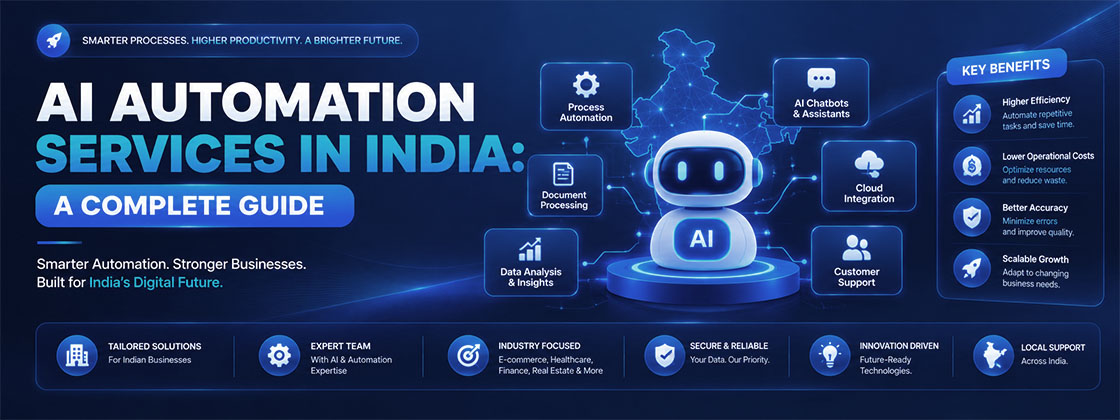
Most Indian businesses still run on manual work — following up leads by hand, copying data between spreadsheets, replying to the same customer questions again and again. AI automation services in India change that by letting software handle the repetitive parts of a workflow, so people can focus on decisions that actually need a human.
Instead of hiring more staff to keep up with volume, companies are connecting AI to their existing systems — CRM tools, WhatsApp, email, and internal databases — to move information and trigger actions automatically.
We work with SMBs and mid-market businesses across India on exactly this problem, and one pattern holds up again and again: the businesses that see results fastest aren't the ones with the most sophisticated tooling — they're the ones that automate the right two or three processes first, instead of trying to automate everything at once.
This guide covers what AI automation services actually do, how they work, real pricing bands in India, and how to choose the right automation partner — so you know exactly where AI automation fits into your business before you spend a rupee on it.
What Are AI Automation Services?
AI automation goes a step beyond basic rule-based automation. A rule-based system only follows fixed "if this, then that" logic — it breaks the moment something outside the rule shows up.
Automation solutions, on the other hand, can read and interpret information — an email, a form response, a customer message — and decide what to do with it, even when the input isn't structured the same way twice.
For example, if a lead fills out a contact form with an unusual, oddly-worded query, a rule-based system might just ignore it. An AI system can read the intent behind the message, qualify the lead, and route it to the right salesperson — without anyone touching a spreadsheet.
How Do AI Automation Services Work?
Most AI automation follows the same basic sequence:
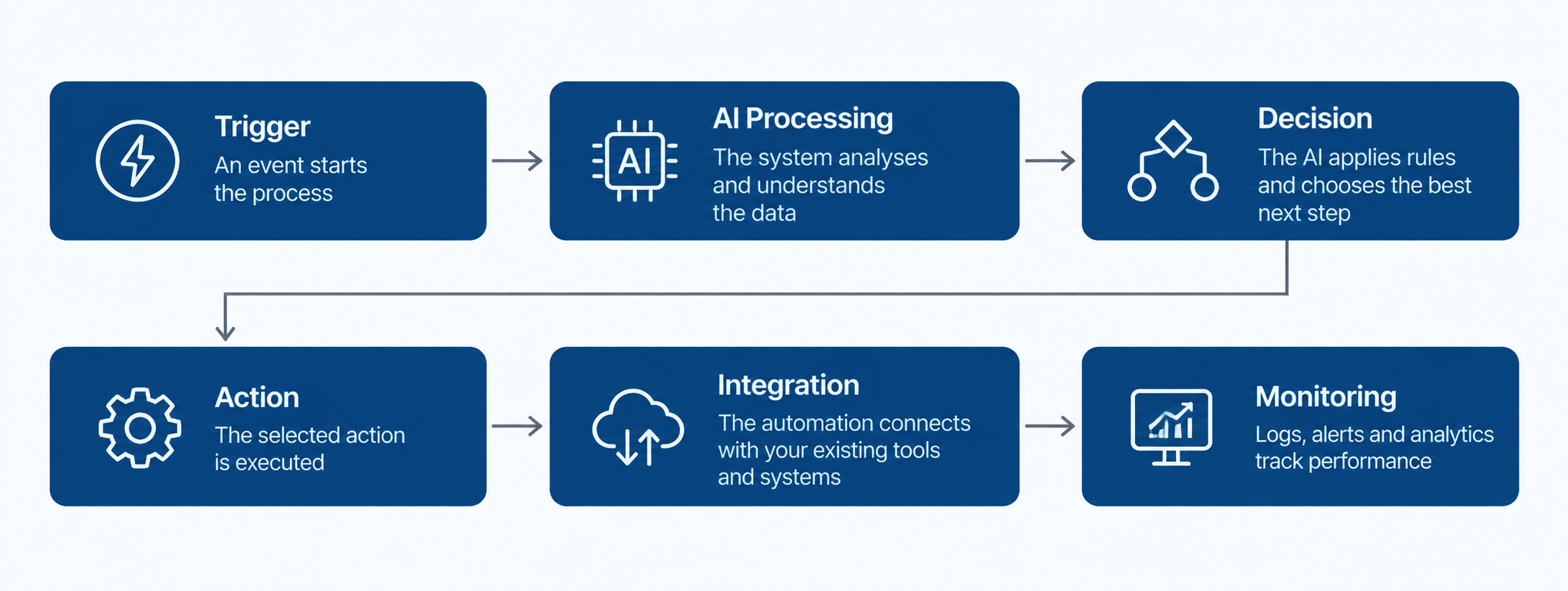
A website form submission (trigger) is read by an AI model (processing), which decides whether the lead qualifies (decision), updates the CRM, and notifies the sales team (action) — all connected through system integrations, with performance tracked over time (monitoring).
Example: A website visitor fills out a lead form. The AI qualifies the lead based on intent and budget signals, updates the CRM record automatically, alerts the assigned salesperson, and sends a personalized follow-up — all within seconds, with zero manual data entry.
What AI Automation Services Can Businesses Use?
Most companies don't need every automation type on day one — they need the two or three that solve their biggest bottleneck first. The table below breaks down the core building blocks so you can identify which ones map to your own process gaps.
This is also the core of what an AI & Workflows engagement typically covers, whether it's bundled with CRM setup or added to an existing system.
| Service | What It Does |
| AI Workflow Automation | Automates multi-step internal processes across teams and tools |
| CRM Automation | Keeps customer and lead records updated automatically as data changes |
| AI Sales Automation | Qualifies leads, schedules follow-ups, and routes deals to the right rep |
| AI Marketing Automation | Personalizes campaigns and triggers actions based on customer behavior |
| AI Customer Support Automation | Handles common queries instantly, escalates complex ones to a human |
| WhatsApp AI Automation | Manages customer conversations, orders, and reminders on WhatsApp |
| AI Agent Automation | Runs autonomous tasks like research, data entry, and reporting |
| AI Data & Reporting Automation | Collects and structures data into ready-to-use reports |
| API & Software Integration | Connects your existing tools so data flows between them automatically |
AI Automation Use Cases Across Business Operations
Automation rarely lives in just one department — it tends to spread once a team sees the time it saves elsewhere.
The table below maps the most common business functions to the specific automation that typically gets built first. Use it as a starting checklist rather than a requirement to automate all nine at once.
| Business Process | Example Automation |
| Lead generation | Lead capture and qualification |
| Sales | Follow-ups and lead routing |
| Customer support | AI-powered instant responses |
| CRM | Automatic record updates |
| Marketing | Campaign and personalization workflows |
| Finance | Invoice and document processing |
| HR | Candidate screening workflows |
| Operations | Task and approval automation |
| Reporting | Automated data collection and reports |
AI Automation Solutions for Different Industries
The same underlying technology looks different once it's applied to a specific industry's actual buying and service process. A real estate developer's automation priorities are rarely the same as a coaching institute's or a manufacturer's, even though both are technically "lead qualification."
The table below shows one representative example per industry — for the full playbook per sector, the linked pages below go deeper.
| Industry | Example Use Case |
| Real Estate Marketing | Auto-qualifies property inquiries and schedules site visits |
| E-commerce | Recovers abandoned carts and updates order status automatically |
| SaaS | Automates trial-to-paid nudges based on product usage |
| Marketing Agencies | Automates client reporting and campaign performance summaries |
| Healthcare (non-clinical) | Automates appointment reminders and patient intake forms |
| Education Marketing | Automates admission-inquiry follow-ups and document collection |
| Small Businesses | Automates invoicing reminders and repeat-customer follow-ups |
Benefits of AI Automation for Businesses
- Reduces repetitive manual work across teams
- Improves workflow consistency and reduces human error
- Speeds up customer response times
- Connects different business systems that previously worked in silos
- Cuts down on manual data entry
- Improves operational visibility with real-time data
- Frees teams to focus on higher-value, judgment-based work
- Scales repetitive processes without proportionally scaling headcount
AI Automation Tools and Technologies for Businesses
Behind every AI automation setup is a combination of: generative AI models, AI agents, large language models, APIs, CRM automation services, workflow automation platforms, chatbots, databases, and business-software integrations.
The right combination depends on which systems your business already runs on — a good automation partner maps this before recommending anything, rather than selling you a fixed stack.
How Much Do AI Automation Services Cost in India?
There's no honest way to quote a single fixed price without first understanding the workflow — but that doesn't mean pricing has to be a mystery. What actually determines cost is:
- Workflow complexity
- Number of automations required
- Number of system integrations
- AI/API usage volume
- Custom development needs
- Data requirements and cleanup
- Testing across edge cases
- Ongoing maintenance and monitoring
AI automation pricing in India can vary significantly depending on the workflow complexity, number of integrations, AI capabilities, and level of ongoing support required. Basic CRM and lead-capture automation may fall within a lower monthly range, while advanced sales automation, AI chatbots, lead scoring, and multi-location RevOps systems can require substantially higher budgets.
Rather than comparing prices alone, businesses should evaluate the scope of automation, integrations, customization, maintenance, and expected business outcomes before choosing a solution.
How to Choose an AI Automation Company in India
- Understand your automation requirements before evaluating vendors
- Review relevant experience — ask to see real case studies with numbers, not just client logos
- Check integration capabilities with your existing CRM and tools
- Ask directly about security and data handling practices
- Understand the implementation timeline and process
- Check what ongoing support looks like after go-live
- Define measurable business objectives upfront, not just deliverables
How to Implement AI Automation in Your Business
1. Identify repetitive processes that consume the most manual time
2. Analyze the current workflow, including where it breaks down
3. Select automation opportunities with the clearest ROI
4. Choose AI tools and integrations that fit your existing stack
5. Build the workflow with clear triggers and actions
6. Test the workflow, including edge cases, before full rollout
7. Monitor performance and optimize based on real data
AI Automation vs Traditional Automation
It's worth being precise about the difference, since the two terms get used interchangeably in vendor pitches. Traditional automation is fast and reliable for fixed, predictable steps, but it has no way to handle anything outside its rules.
AI automation trades some of that predictability for the ability to handle messier, real-world input — which is exactly the kind of input most customer-facing processes actually produce.
| AI Automation | Traditional Automation |
| Can process varied, unstructured information | Usually follows predefined rules |
| Can work with natural language | Usually depends on structured inputs |
| Supports flexible, adaptive workflows | Generally follows fixed workflows |
| Can combine AI with business systems | Primarily executes predefined actions |
Common AI Automation Mistakes Businesses Should Avoid
- Automating a poorly designed process instead of fixing it first
- Automating without a clear business objective
- Choosing tools before understanding the workflow
- Ignoring data quality — automation amplifies bad data
- Not testing edge cases before full rollout
- Removing necessary human oversight from sensitive decisions
- Ignoring monitoring and maintenance after launch
- Failing to measure results against the original objective
Why Choose AI Automation Services in India?
AI adoption in India is changing how businesses manage repetitive tasks, customer interactions, marketing, and internal operations. As organizations move away from manual processes, AI automation is increasingly being used to connect business systems, streamline workflows, and reduce time spent on routine work. However, successful automation depends on how well it fits the company’s existing processes and technology.
For Indian businesses, this often means connecting tools such as CRM platforms, spreadsheets, communication systems, and other business applications rather than replacing them completely.
EvoKast approaches AI automation by first understanding existing workflows and then identifying where AI, integrations, and automation can improve efficiency. This helps businesses build connected processes that can be monitored, adjusted, and scaled as their needs change.